
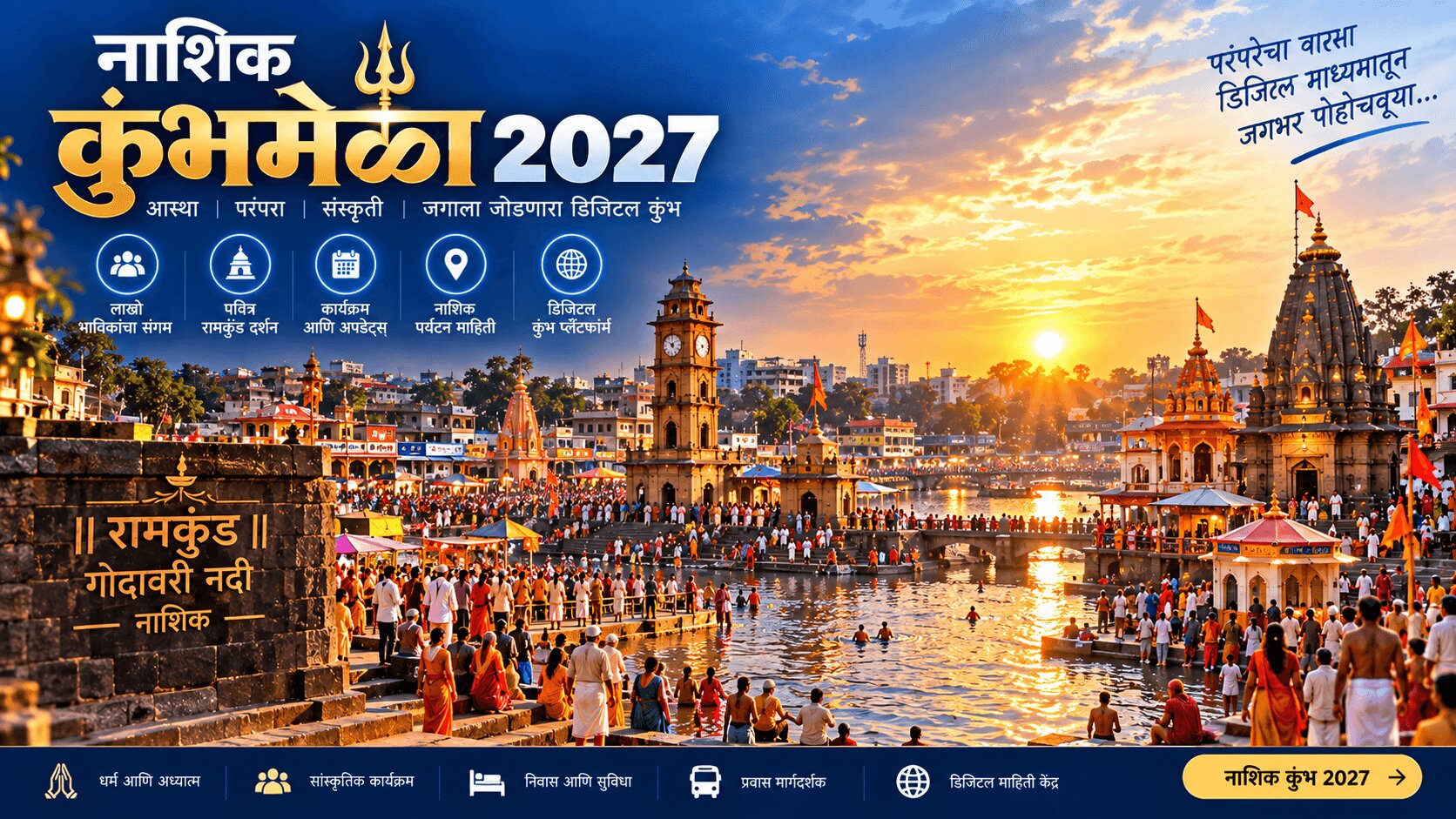
TL;DR — The Nashik Simhastha Kumbh Mela 2027 runs from 31 October 2026 to 24 July 2028, with the main Shahi Snan around 2 and 31 August 2027. The government is running it as a Digital Kumbh — AI assistants, an Integrated Command & Control Centre, digital twins and smart infrastructure. Tens of millions of visitors mean a once-in-12-years business surge across hospitality, retail, transport, tourism and digital services. As a Nashik-based AI and software company, Devonstank helps local businesses and organisers capture it with apps, e-commerce, AI assistants and command dashboards.
What is the Nashik Kumbh Mela — and why 2027 matters
The Simhastha Kumbh Mela at Nashik and Trimbakeshwar is one of India's largest religious gatherings, held on the banks of the Godavari roughly once every twelve years. The last Nashik Simhastha was in 2015. The next cycle — the Kumbh Mela 2027 — is now in active preparation, with the full mela period spanning 31 October 2026 to 24 July 2028 and the peak royal-bath days in August 2027.
Events at this scale reshape a city. Roads, sanitation, accommodation, transport and communication all get built out — and the businesses that prepare early ride the wave instead of scrambling at the peak.
Why they're calling it the “Digital Mahakumbh”
What makes 2027 different from every previous Nashik Kumbh is the explicit push to run it on modern technology. Reported plans for the Digital Kumbh include:
- AI assistant (“Kumbhdoot”) — digital guidance for pilgrims: routes, timings, facilities, help.
- Integrated Command & Control Centre (ICCC) — real-time crowd and security monitoring.
- Digital-twin modelling — simulate crowd flow and infrastructure before the event.
- Smart parking & mobility — managing millions of vehicles and movements.
- Facial-recognition, missing-person tracing & surveillance — safety at massive scale.
In other words, the state is treating the Kumbh as a large-scale technology programme. That sets the tone — and the expectation — for every business and vendor around it.
A crowd of tens of millions isn't a marketing event — it's a systems problem. The winners in 2027 will be the ones who prepared their operations, not just their inventory.
Where the business opportunity is
A gathering this size lifts almost every local sector. The question isn't whether demand comes — it's whether you can capture and serve it without breaking.
| Sector | The opportunity | The digital enabler |
|---|---|---|
| Hospitality & stays | Hotels, dharamshalas, tents, homestays at capacity | Online booking, WhatsApp reservations, dynamic availability |
| Food & retail | Huge footfall for food, essentials, religious goods | E-commerce, WhatsApp ordering, digital payments, delivery |
| Transport & travel | Cabs, buses, tours, parking | Booking apps, live schedules, smart-parking integration |
| Tourism & guides | Darshan planning, local experiences | Pilgrim apps, AI assistants, multilingual info |
| Manufacturers & wholesalers | Supplying goods at scale to the region | Online catalogs and B2B ordering portals |
| Healthcare & services | Clinics, pharmacies, emergency support | Locators, queue and appointment systems |
| Organisers & civic bodies | Crowd, safety, logistics operations | Dashboards, command centres, data pipelines |
The three ways businesses lose the Kumbh opportunity
- Not online in time — visitors search and book on their phones. If you're not findable and bookable digitally, you're invisible to most of them.
- Can't handle the surge — a site that crashes or a WhatsApp line that drowns loses money at the exact moment it matters.
- No data — without analytics you can't see demand, adjust pricing or plan stock for a once-in-12-years spike.
How to prepare digitally — and how Devonstank helps
We're a Nashik-headquartered software and AI company. That local base plus AI-first engineering is exactly what a moment like this needs. Practical ways to get ready:
- Get online early — a fast e-commerce store or booking site, live well before the peak. For eligible SMEs and manufacturers we can even build and run it on a commission basis.
- Sell and book on WhatsApp — WhatsApp AI messaging to take orders, bookings and enquiries at scale without a call centre.
- Pilgrim apps & AI assistants — multilingual mobile apps and AI assistants for routes, timings, facilities and FAQs.
- Command dashboards & analytics — AI analytics and dashboards for real-time demand, footfall and operations.
- Custom software — queue, ticketing, volunteer, vendor and logistics systems for organisers and large operators.
- Scale & reliability — cloud and DevOps so your platform survives the surge instead of buckling under it.
Start now, not in August 2027
The peak is the deadline, not the start line. Booking systems, stores, apps and dashboards need to be live, tested and ranking in search months before the crowds arrive. Twelve years is a long time to wait for the next one — the preparation window is now.
Frequently asked questions
When is the Nashik Kumbh Mela 2027?
The Nashik-Trimbakeshwar Simhastha Kumbh Mela runs from 31 October 2026 to 24 July 2028, with the main Shahi Snan (Royal Bath) dates around 2 August 2027 and 31 August 2027.
What is the Digital Mahakumbh / Digital Kumbh?
The plan to run the 2027 Simhastha as the most technology-enabled Kumbh yet — AI assistants, an Integrated Command and Control Centre, digital-twin modelling, smart parking, surveillance and missing-person tracing for crowd management and pilgrim safety.
What business opportunities does the Kumbh Mela 2027 create?
Tens of millions of visitors create demand across hospitality, transport, retail, food, tourism, healthcare and digital services — plus opportunities to sell online, build booking and pilgrim apps, and supply technology for crowd, safety and logistics operations.
How can my business prepare digitally?
Get online early with an e-commerce or booking site, enable WhatsApp ordering and bookings, build a mobile app or AI assistant, and instrument analytics to handle the surge. A local technology partner can build and run these quickly.
Why work with a Nashik-based technology partner?
Local presence means we understand the ground reality, can move fast, and are on hand through the event — combined with AI-first engineering built for scale.
Planning for the Kumbh 2027 surge?
Let's map your digital readiness — store, bookings, app or dashboard — while there's still runway.