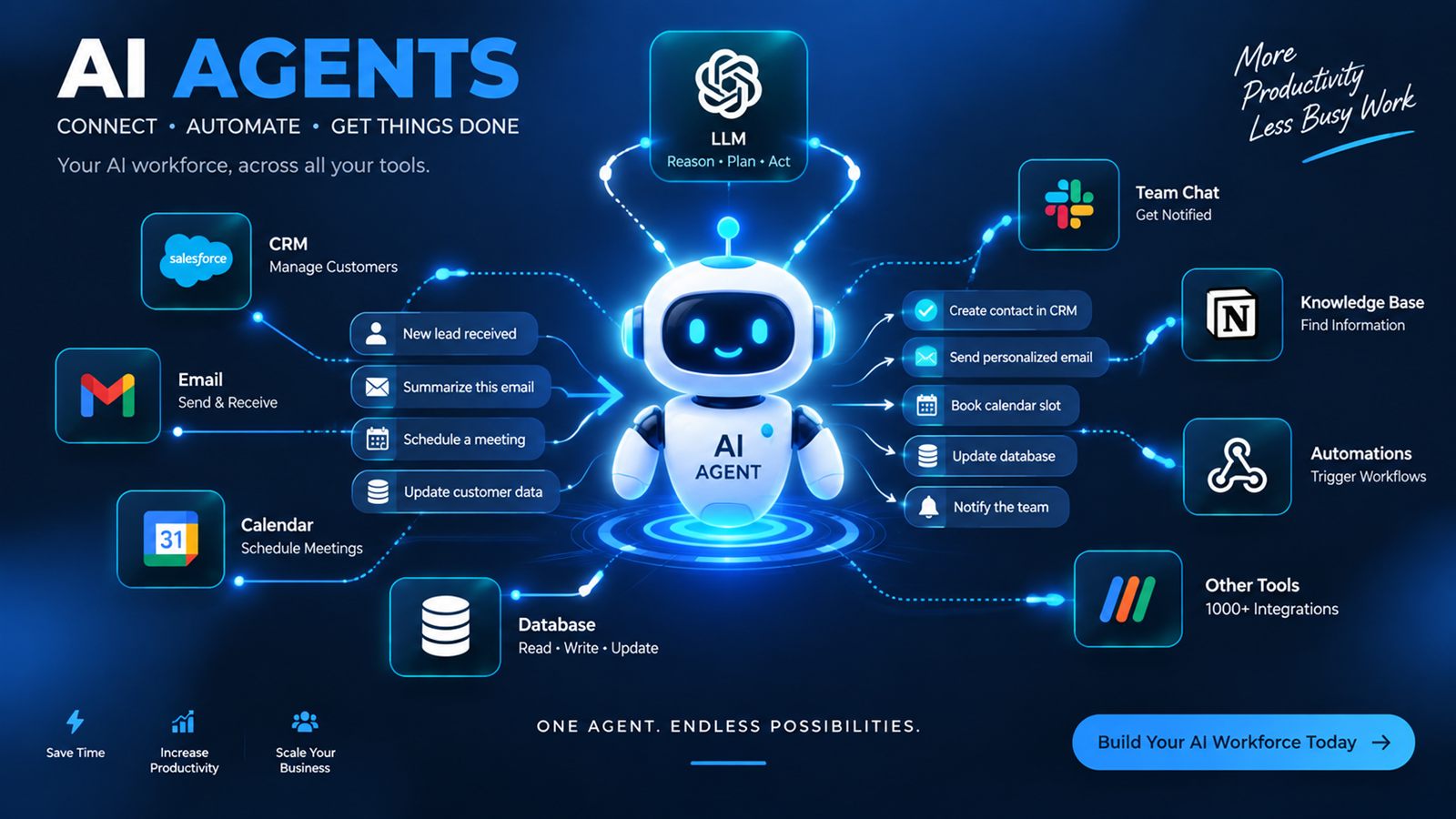
TL;DR — A chatbot answers; an agent acts. Agents plan multi-step tasks, call tools and APIs, and complete work end to end with human-in-the-loop control. Devonstank ships them as AI Agents, Smart Workflows and Automations — start with one high-friction workflow, prove the savings, then expand.
The core difference
The word “chatbot” carries a decade of baggage — scripted trees, dead ends, “I didn't understand that.” Modern AI agents are a different category. Instead of only producing text, an agent decides what to do, uses tools to do it, checks the result, and continues until the task is complete.
| Chatbot | AI Agent | |
|---|---|---|
| Output | A reply | A completed task |
| Tools | None (talks) | Calls APIs, updates systems |
| Steps | One turn | Plans and executes many |
| Memory | The conversation | State across a workflow |
| Value | Deflects a question | Removes the manual work |
What agents actually do for a business
- Sales — qualify inbound leads, enrich them, log to CRM, book the meeting.
- Operations — read an order, check stock in the ERP, raise the purchase request, notify the team.
- Support — triage a ticket, pull the customer's history, draft a resolution, escalate the hard ones.
- Finance — extract invoice data, match it to a PO, flag mismatches for a human.
These are exactly the Smart Workflows and Automations in our product suite — trigger, plan, act, verify.
The question isn't “can AI answer this?” It's “can AI finish this?” Agents are how you get to yes.
How we build agents safely
Autonomy without control is a liability. Every agent we ship has:
- Scoped permissions — an agent can only touch the systems and actions it's granted.
- Human-in-the-loop — high-impact steps (payments, sends, deletes) require approval.
- Reversibility — actions are logged and, where possible, undoable.
- Full audit trail — every decision and tool call is traceable for compliance.
- Evaluation — agents are tested against graded task suites, not vibes.
Where to start
Don't boil the ocean. Pick one workflow that is high-volume, rule-heavy and annoying. Ship an agent for it in a 4–8 week pilot, measure the time and error reduction, then expand to the next. That is how our AI & Generative AI team turns agentic hype into a line item that pays for itself.
Frequently asked questions
What is the difference between a chatbot and an AI agent?
A chatbot answers questions with text. An AI agent takes action — it plans steps, calls tools and APIs, updates systems and completes tasks end to end, with human approval where it matters.
What can AI agents actually automate?
Order processing, lead qualification and CRM updates, invoice and document handling, ticket triage, report generation, and multi-step back-office workflows across existing tools.
Are AI agents safe to run without supervision?
We design human-in-the-loop controls, permission scopes, audit logs and reversible actions. High-impact steps require approval and every action is traceable.
How do we start with AI agents?
Start with one high-friction workflow, ship an agent for it in a 4–8 week pilot, measure the savings, then expand.
Have a workflow worth automating?
Tell us the most annoying repetitive task in your business — we'll scope an agent for it.