
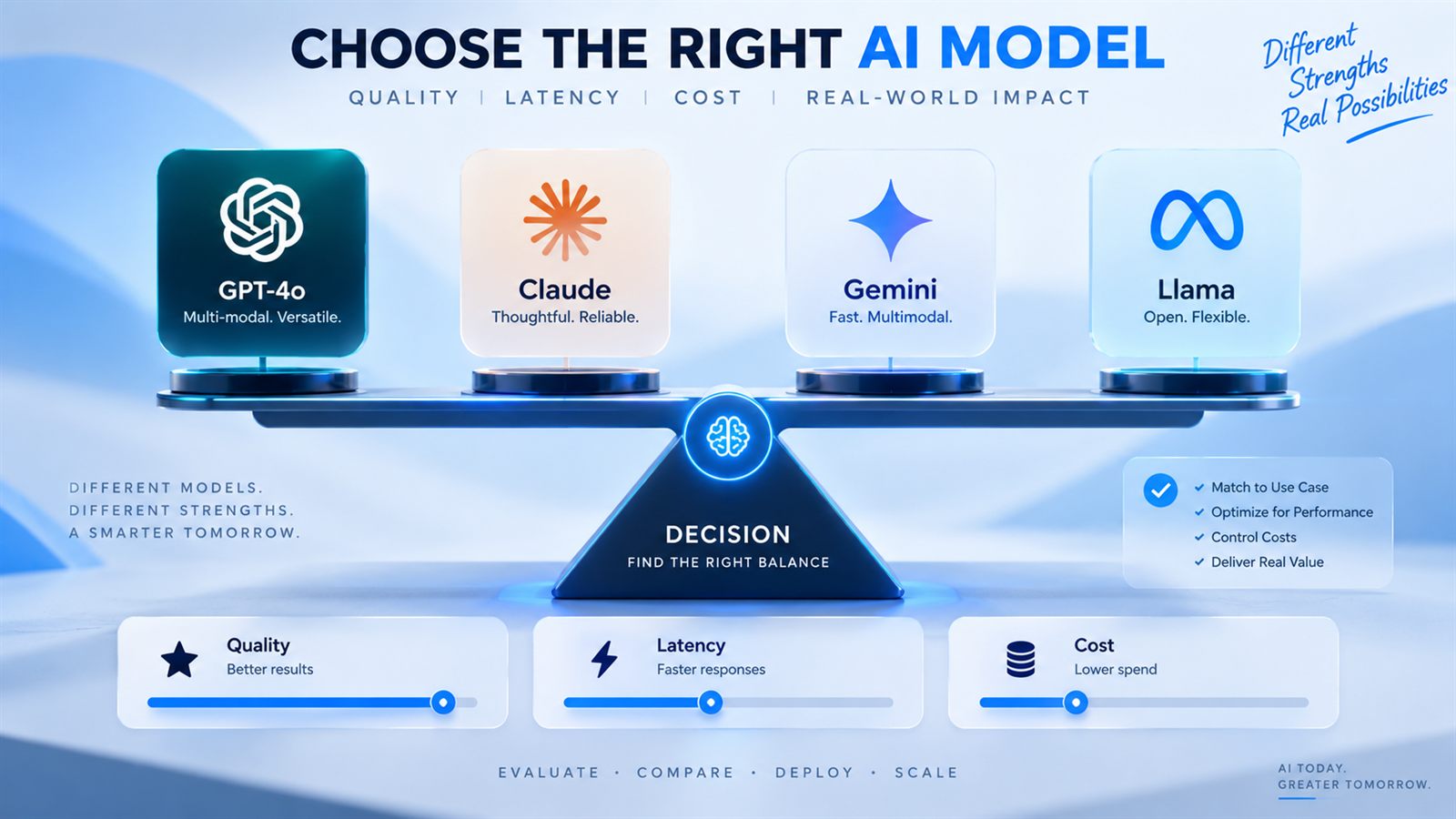
TL;DR — There is no single best AI model. Choose per task on quality, latency, cost, context length, privacy and language coverage. Build a provider-agnostic layer so you can route different jobs to different models and swap as the market moves. Devonstank benchmarks candidates on your real data before committing.
Stop asking “which model is best”
It's the wrong question. The frontier models leapfrog each other every few months, and the “winner” changes by task. A model that writes beautiful marketing copy may be mediocre at strict JSON tool-calling. A model that reasons brilliantly may be too slow or too expensive for a high-volume classification step.
The right question is: which model for which job, and how do I stay free to change my mind? That mindset is the core of our AI / ML development practice.
The six factors we weigh
| Factor | Ask |
|---|---|
| Quality | Does it get your task right, measured on a graded set — not a leaderboard? |
| Latency | Is it fast enough for the interaction? Users feel every second. |
| Cost | What does it cost per task at your real volume, not per token in isolation? |
| Context | Can it hold the documents and history the task needs? |
| Privacy | Can the data leave your infrastructure? If not, open-weight and self-hosted win. |
| Language | Does it handle your users' languages — including Indian languages — well? |
Pick models per task, not per press release. The only benchmark that matters is your own data.
Mix models on purpose
Real products rarely use one model. A well-built system routes:
- A small, cheap model for routing and classification.
- A mid model for retrieval-augmented answers.
- A large model only for the hard reasoning or final customer-facing output.
- An open-weight, self-hosted model where data can't leave your walls.
This cuts cost dramatically without hurting perceived quality — the same discipline we apply in our AI Conversations SaaS.
Build for change: the provider-agnostic layer
We put a thin abstraction between your product and any single provider, so switching models is a config change, not a rewrite. When a better or cheaper model ships next quarter — and it will — you adopt it in a day, not a sprint.
How we decide, concretely
We build a graded evaluation set from your real use cases, run every candidate model through it, and compare quality, latency and cost per task. The choice becomes evidence, not opinion. Then we wire the winner (or the mix) into production with the guardrails from our pilot-to-production playbook.
Frequently asked questions
Which AI model is best for my product?
There is no single best model. It depends on the task — reasoning quality, latency, cost, context length, privacy and language coverage. We benchmark candidates on your real data before committing.
Should I commit to one AI provider?
No. We build a provider-agnostic layer so you can route different tasks to different models and swap providers without a rewrite.
When should I use open-weight models?
When data must stay on your infrastructure, when you need full cost control at scale, or when a fine-tuned smaller model beats a general large one on your narrow task.
How do you decide, concretely?
We run each candidate against a graded evaluation set built from your real use cases, then compare quality, latency and cost per task.
Not sure which model fits?
We'll benchmark the options on your real use case and hand you the evidence.