
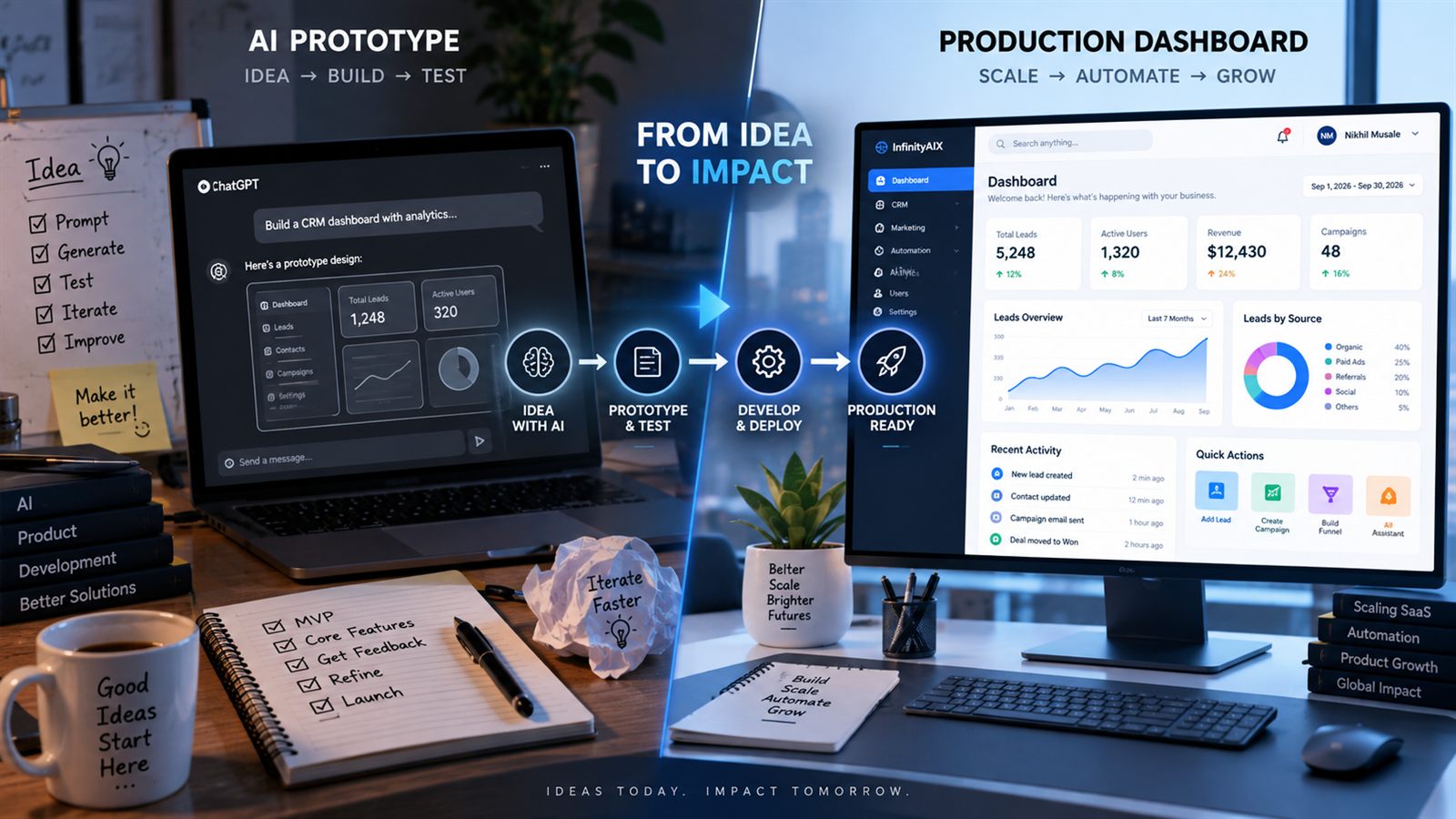
TL;DR — A demo proves an idea is possible. Production proves it is trustworthy, affordable and owned. The pilots that ship are the ones that pass five gates: evaluation, guardrails, cost control, observability and ownership. Devonstank hardens pilots against these gates in a focused 4–8 week engagement.
Why most GenAI pilots stall
We meet a lot of teams with an impressive prototype and a stuck roadmap. The prototype answers three cherry-picked questions beautifully. Then someone asks: what happens on the four-hundredth question, from a real customer, at 2am, when the model is wrong and confident? Silence.
The pilot was optimized for a demo. Production is a different objective function. It is not smarter prompts — it is the unglamorous engineering that sits around the model call. That is where our AI & Generative AI work spends most of its time.
Pilot vs production: what actually changes
| Dimension | Pilot mindset | Production mindset |
|---|---|---|
| Correctness | “It worked in the demo” | Measured against a graded eval set on every change |
| Failure | Ignored | Designed for — fallbacks, refusals, human handoff |
| Cost | Unknown | Instrumented per request, budgeted per tenant |
| Visibility | Console logs | Traces, dashboards, alerting |
| Ownership | “The data scientist” | A team with an on-call rota and a runbook |
The five gates
1. Evaluation you can run on every change
We build an eval harness from day one: golden question/answer pairs with rubric grading, hallucination probes whose answers are deliberately not in the knowledge base, and tool-use traces. Nothing ships unless the eval score holds or improves. This is the single biggest predictor of whether a pilot survives contact with users.
2. Guardrails and graceful failure
Production systems say “I don't know” well. We add input validation, output filtering, refusal paths, and clean escalation to a human when confidence is low. A model that admits uncertainty beats a model that invents.
3. Cost control
LLM bills surprise everyone once. We instrument token, model and tool cost per request, then route cheap models for classification and retrieval and reserve large models for the final answer. Prompt caching, streaming with early termination and per-tenant budgets keep a runaway integration from becoming a runaway invoice.
The hardest part of a GenAI product isn't the model call — it's everything around the model call.
4. Observability
You cannot fix what you cannot see. Every conversation is traceable end to end — retrieval hits, tool calls, latency and cost — feeding dashboards and alerts. Our cloud & DevOps practice wires this in as standard.
5. Ownership
A production AI feature is a product, not a project. It needs an owner, a runbook and a feedback loop that turns real conversations into the next round of improvements. Where a client wants us to keep operating it, we run it under an SLA.
Where this shows up in our products
These gates are baked into everything we ship — our AI Conversations SaaS, our WhatsApp AI messaging platform, and the AI Agents, Smart Workflows and Automations in our product suite. Same discipline, different surface.
How we engage
- Discovery sprint — a 4–8 week pilot hardened against the five gates, with a go/no-go on ROI.
- Embedded squad — senior engineers building alongside your team and handing over.
- Managed product — we design, build and operate it under your brand and an SLA.
Frequently asked questions
Why do most GenAI pilots fail to reach production?
They optimize for a good demo, not for evaluation, guardrails, cost predictability, observability or ownership. Without those five gates a pilot cannot be trusted with real users, so it stalls.
How long does it take to move an AI pilot to production?
With a focused scope, typically 4 to 8 weeks — depending on data readiness, compliance needs and how many channels it must run on.
How do you keep LLM costs predictable?
Cheap models for classification and retrieval, large models only for the final answer, aggressive prompt caching, streaming with early termination, and per-tenant budgets with alerts.
Do you lock us into one LLM provider?
No. We are model-agnostic — Claude, GPT, Gemini or open-weight models, chosen per use case on quality, latency and cost.
Have a pilot that's stuck?
Let's pressure-test it against the five gates and map the path to production.