TL;DR — A CRM organises your customers, deals and follow-ups. Off-the-shelf tools (Salesforce, HubSpot, Zoho) are great when your process fits theirs. Custom CRM development wins when your sales process is unusual, per-seat licences hurt as you grow, you need deep integration with your own systems, or you want to own the data and roadmap. Modern CRMs add AI lead scoring and next-best-action. Devonstank builds the version your team will actually use.
What a CRM is really for
Strip away the buzzwords and a CRM does one job: make sure no customer, lead or follow-up falls through the cracks — and give leaders a clear view of the pipeline. Everything else (automation, reporting, AI) exists to serve that. A CRM your team avoids is worse than no CRM, because the data goes stale and the reports lie.
What modern CRM development includes
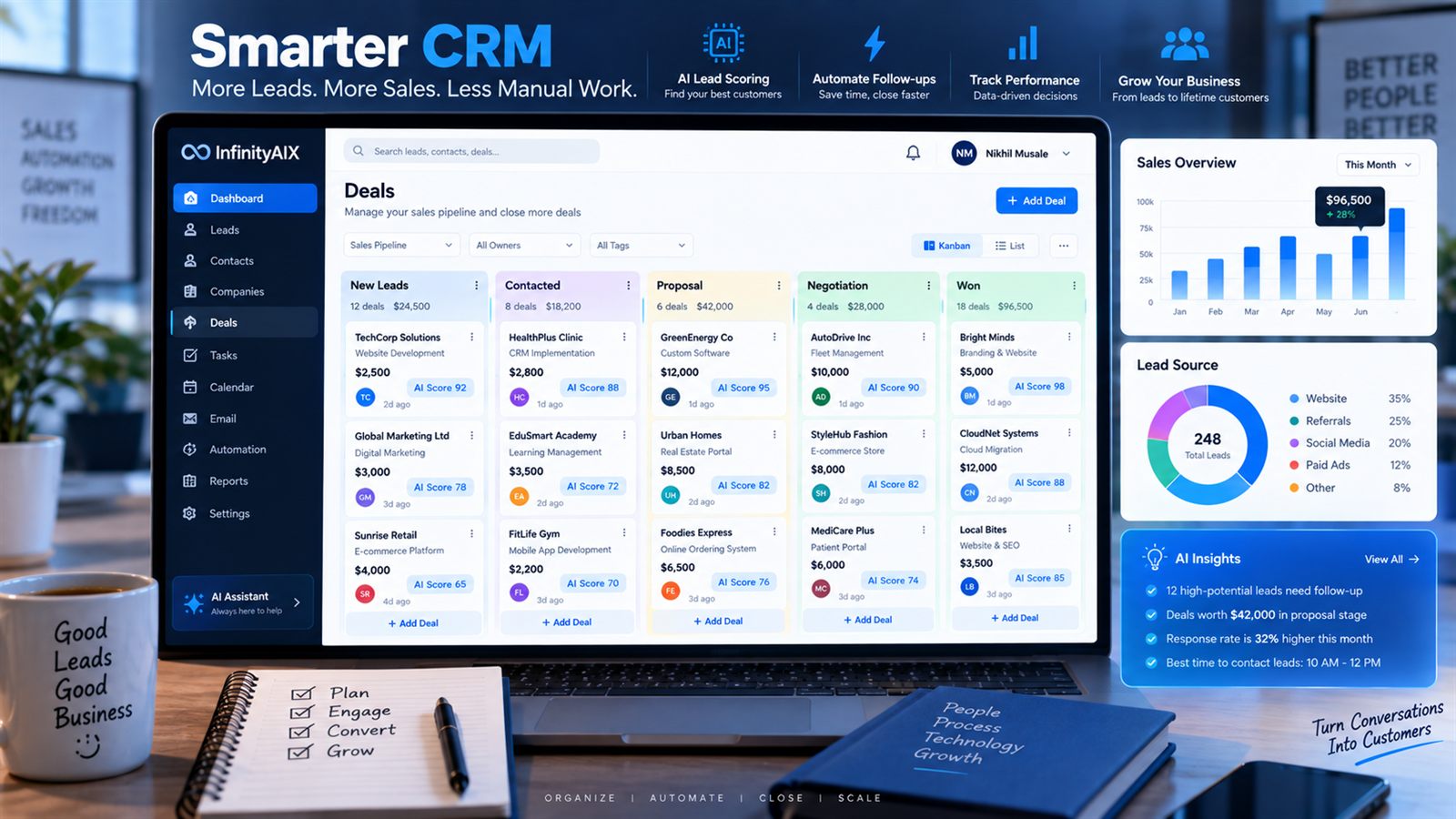
- Contacts & accounts — a single, clean source of truth for every relationship.
- Visual pipelines — deals moving through stages your team actually uses.
- Activities & tasks — calls, meetings, follow-ups, reminders — nothing forgotten.
- Automation — assignment rules, follow-up sequences, alerts on stalled deals.
- Reporting — forecasts, conversion, rep performance — on dashboards, not spreadsheets.
- Integrations — email, WhatsApp, telephony, billing, your ERP and marketing tools.
- Role-based access — the right people see the right data, with an audit trail.
Custom vs off-the-shelf: how to decide
| Choose off-the-shelf when… | Choose custom when… |
|---|---|
| Your process fits a standard sales model | Your sales process is unusual or highly specific |
| You want to launch in days | You need deep integration with your own systems |
| Team size is small and stable | Per-seat licence costs scale painfully as you grow |
| Standard features are enough | You want to own the data, UX and roadmap |
Often the answer is a hybrid: keep a platform where it fits, and build custom modules or a custom front end where it doesn't. We help you make that call honestly — we don't sell complexity you don't need.
The best CRM is the one your sales team opens without being told to. Adoption is the whole game.
Where AI changes the CRM
This is where a modern build pulls ahead. With AI woven in, a CRM can:
- Score and prioritise leads so reps work the ones most likely to close.
- Draft follow-ups and summarise long email or call threads in seconds.
- Flag at-risk deals that have gone quiet, before they're lost.
- Suggest the next best action for each contact, grounded in your real data.
The goal is simple: less data entry, more selling.
How we build it
- Map the process — how you actually sell, not a textbook version.
- Design for adoption — fewer clicks, mobile-friendly, fits daily habits.
- Build & integrate — pipelines, automation and connections to your stack.
- Roll out & iterate — train, measure adoption, refine what gets ignored.
Flexible ways to work with us
We build CRMs as a fixed-scope project, an embedded squad alongside your team, or a fully managed product we design, build and operate. Whichever fits, we start by understanding your sales reality first.
Frequently asked questions
What is CRM development?
The design and engineering of a customer relationship management system — contacts, pipelines, activities, automation, reporting and integrations — tailored to how a specific business sells and serves customers.
Custom CRM or Salesforce / HubSpot / Zoho?
Off-the-shelf is great when your process fits their model and you want a fast start. Custom makes sense when your process is unusual, licence costs scale painfully, you need deep integration, or you want to own the data and roadmap.
What does a modern CRM include?
Contacts and accounts, visual pipelines, activity tracking, automation, reporting dashboards, role-based access, and integrations with email, WhatsApp, telephony, billing and marketing — increasingly with AI lead scoring.
How does AI help in a CRM?
It scores and prioritises leads, drafts follow-ups, summarises conversations, flags at-risk deals and suggests the next best action — so teams spend time selling, not on data entry.
Outgrowing your CRM?
Let's map your sales process and design a CRM your team will actually use.